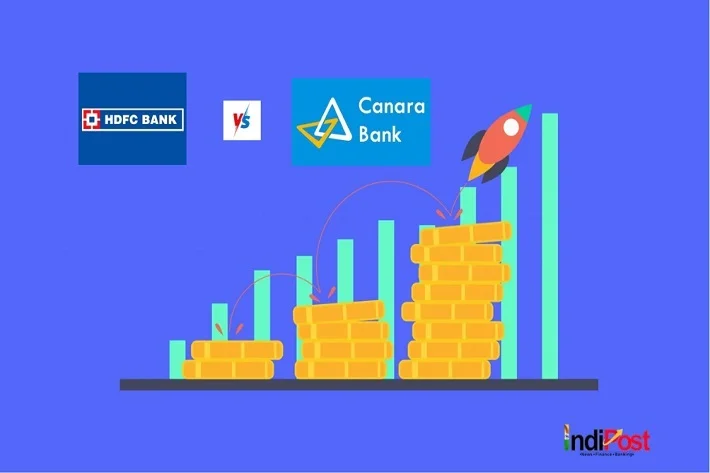
Not all banking stocks tell the same story. Investors who treat the banking sector as a monolithic category – buying any bank stock when “financials are bullish” often find that their thesis was right about the sector but wrong about the specific name they chose. HDFC Bank share price and Canara Bank share price sit in the same sectoral index but behave like products of two different economies. Understanding why that is the case is more useful than tracking either chart in isolation.
Two Banks, Two Completely Different Business Architectures
HDFC Bank is a private-sector institution built on a retail liability franchise, fee-income diversification, and credit underwriting discipline that has compounded over three decades. HDFC Bank Share Price has historically traded at a significant premium to book value – not because the market is being generous, but because the bank’s return on equity, asset quality consistency, and management track record justify that premium over long periods.
Canara Bank Share Price reflects a different set of realities. As a public sector undertaking, Canara Bank operates with a mandate that includes priority sector lending targets, government scheme implementation, and a customer base that skews heavily toward rural and semi-urban India. Its valuation trades at a discount to private peers – not because the business is failing, but because PSU banks carry structural constraints that limit the kind of return profile private banks generate.
What Drives HDFC Bank Share Price Movement
HDFC Bank Share Price is sensitive to a specific set of triggers that sophisticated investors track quarterly. Net interest margin trajectory, the pace of deposit mobilisation relative to credit growth, and asset quality in the unsecured retail book are the three variables that most consistently move the stock.
The merger with HDFC Limited added balance sheet complexity that the market spent several quarters digesting. Investors tracking HDFC Bank Share Price through that transition period watched the stock underperform its private sector peers despite operationally sound results – a reminder that even fundamentally strong businesses go through phases where the market needs time to recalibrate its valuation framework.
| You May Like to Read: HDFC Life Click 2 Protect 3d Plus: Review Plan & Details
What Drives Canara Bank Share Price Movement
The share price of Canara Bank responds to a completely new screen. Gross NPA reduction trajectory, slippage ratios, and the pace of recovery from stressed corporate accounts dominate analyst conversations around the stock. The most important external factors are government capital injection options, RBI comments on PSU bank health, and budget amounts for infrastructure spending, because Canara is highly exposed to project finance.
PSU bank stocks, including Canara, periodically run hard when the market rotates into value – typically during phases when private bank valuations look stretched, and investors seek cheaper exposure to the banking sector’s growth narrative. These rotations can be sharp and rewarding, but rarely sustain for as long as private bank rallies do.
Reading the Two Together
A good sign of how the Indian banking industry is currently selling quality versus value is the difference between the share prices of HDFC Bank and Canara Bank at any given time. A narrowing gap typically signals broad sector optimism. A widening gap signals flight to quality – investors paying up for certainty when the macro environment feels uncertain.
That ratio tells experienced banking sector investors more than either stock does alone.