With a total of more than 1.8 lakh businesses operating across the country, with over 1.6 lakh DPIIT-recognized startups and 125 unicorns, India is now the third-largest startup ecosystem in the world. In FY25-26 alone, around 50% of the startups registered were from Tier-II or non-metro cities in the nation. This data proves that entrepreneurship is profoundly rising in smaller cities, with founders experimenting with varying ideas and business plans.
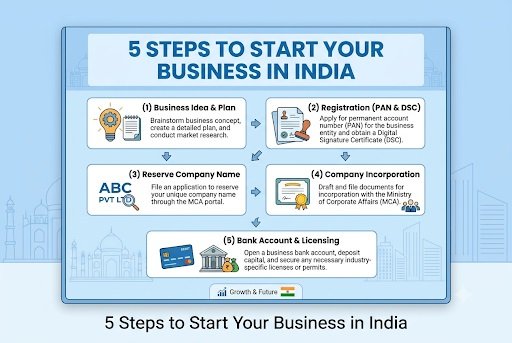
However, a great idea is just the starting point. If it’s to know the procedure for company registration in India, it’s essential to get the fundamentals right from the beginning. Here are five legal steps every founder should take before starting up.
Step 1: Choose the Right Business Structure
The first choice you make will dictate the rest of your business’s growth. There are various business structures through which you can incorporate, such as a Sole Proprietorship, a Partnership, a Limited Liability Partnership (LLP), a One Person Company (OPC), and a Private Limited Company. These structures have varying legal, tax, and fundraising ramifications.
A Private Limited Company is the most preferred option for entrepreneurs who wish to scale via equity funding and enjoy the benefits of limited liability and a separate legal entity. An OPC is a type of private limited company used by sole entrepreneurs who do not wish to include a co-founder but want liability protection. Choose the structure that matches your long-term plans, not just your first year.
Step 2: Pick a Name and Run a Trademark Search
Before you select your business name, make sure to check whether it can be legally used. Start with a Trademark search on the IP India public database to confirm your proposed name, and eventually, your logo, isn’t already registered by someone else. You can also utilize the third-party Trademark Search tools to get instant results.
After a successful trademark check, you can reserve the name on the MCA website. Having a clean and unique name is an asset you can guard and create a brand around.
Step 3: Complete your Company Registration in India
The Company Registration process in India is now handled entirely online with the introduction of the integrated SPICe+ form from the Ministry of Corporate Affairs (MCA). All proposed directors are required to have a Class 3 Digital Signature Certificate. The Director Identification Number (DIN) is issued in the same form.
Fortunately for new founders, there is no minimum paid-up capital, and companies with authorized capital up to ₹15 lakh do not have to pay any MCA filing fee. After verification of documents and electronic submission of the Memorandum and Articles of Association, Corporate Identity Number, PAN & TAN, the founders will get a certificate of incorporation by the Registrar in 10-15 working days.
Step 4: Tax and Mandatory Registrations
A few more registrations make you fully operational. PAN and TAN are allotted automatically during incorporation. GST registration becomes necessary once you cross the turnover threshold or trade across states. Provident fund (EPFO) and employee insurance (ESIC) registrations are handled through the linked AGILE-PRO-S workflow, and some states also require professional tax registration. With these in place, you can open a company’s current account and begin operations.
Incorporation gets you a legal identity; however, your business needs a few more registrations to be fully operational.
- Once the threshold limit of (₹10-40 lakh) is crossed or intrastate cross-border trading takes place, GST registration becomes mandatory.
- Provident fund (EPFO) and employee insurance (ESIC) registrations are linked to the AGILE-PRO-S workflow. Some states may also mandate Professional Tax Registration. These provide the means to establish a company’s current bank account and get business underway.
Step 5: Stay Compliant After Incorporation
Launching is not the finish line. You have to submit Form INC-20A, the declaration of commencement of business, within 180 days of incorporation. In addition to this, companies have to keep statutory registers and hold board meetings, as well as file annual returns and income tax returns on time.
Failure to meet these deadlines may result in penalties, so many founders hire a professional to help with the compliance requirements, while they concentrate on the business.
| You May Like to Read: 10 Things You Should Know Before Starting a Business
Conclusion
The process of starting a business in India has become much easier and smoother, thanks to the digital reforms. With these five legal steps performed in the right order, your venture gets a legal structure, a name, a trademark, a tax setup, and compliance.