When I talk to people who have just started a company, they ask about hiring, pricing, and fundraising. Hardly anyone asks about the bank. Then, about eight months in, the same people start complaining. A payment stuck for two days. A statement that won’t download. A co-founder who can’t see the account because the bank wants a signed form and a branch visit.
That’s why digital banking for startups in India is worth a closer look. It’s not glamorous. It simply decides how many hours a small team loses every month to money admin, and how early they find out when cash is about to run thin. With no finance department, that work lands on a founder who already has too much to do.
I’ll go through where startups usually get caught, what digital banking services actually help with, what they don’t fix, and what I’d set up first.
Why a busy company can still be out of cash
Here’s an invented case, so don’t treat the numbers as data. A small startup makes water-level sensors and sells to housing societies and builders. It opens the month with ₹11 lakh. Payroll takes ₹4.8 lakh on the 1st. Rent and power take ₹75,000 on the 5th. The component supplier wants ₹3.2 lakh by the 7th, and couriers and odds and ends take ₹45,000. That’s ₹9.2 lakh out, leaving ₹1.8 lakh.
Small orders bring in about ₹2.4 lakh a month. The big one doesn’t. A builder owes ₹7.5 lakh on an invoice raised on the 10th, with 45-day terms. He pays on day 80.
Next month opens with ₹4.2 lakh. The same ₹9.2 lakh of bills arrives, and the account is about ₹5 lakh short by the 7th, with ₹7.5 lakh owed to the company and nobody to chase but the builder. The product works, the customer is real, and the company is still in trouble.
I see this pattern more than any other. It isn’t bad management. Costs are fixed in date and amount, and income depends on somebody else’s accounts department.
Tracking is the other headache. This company gets paid by UPI, bank transfer, and cheque, depending on the customer. Some payments cover two invoices. Some arrive with only a reference number. Working out which payment belongs to which invoice is called reconciliation, and nearly everyone postpones it. One week’s backlog is a nuisance. One quarter’s is a weekend gone.
And then there’s the account itself. Banks differ on minimum balances, per-transfer charges, daily limits, and how fast a person answers when something breaks. An account that suits a freelancer sending a dozen payments a month can feel cramped for a team paying forty vendors, and what suits you in month three often won’t in month eighteen.
What online banking actually does for you
The big change is that money moves outside office hours. NEFT and RTGS now run round the clock, IMPS settles in moments, and UPI is how plenty of customers expect to pay. If a supplier needs payment on a Saturday, you can pay on a Saturday.
Limits still exist, though, and they differ by bank and account type. They also get revised. Find out yours before you need them. Learning that your daily cap is below the payment you’re sending, with the vendor waiting, is a bad way to find out.
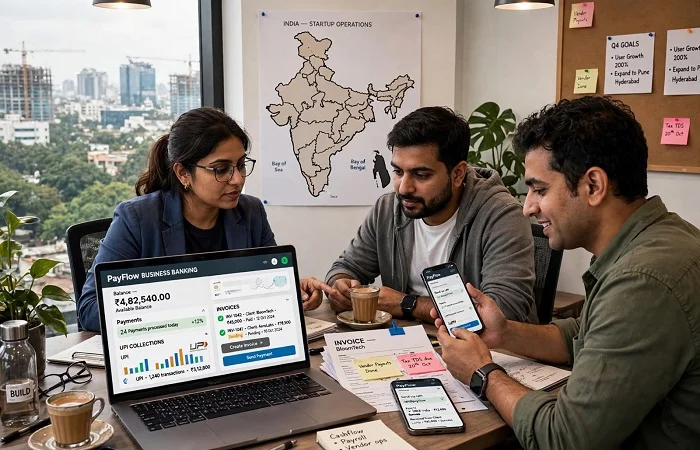
Online payments save you from keeping track of every “transaction” on paper. Your “bank statement” shows who you paid, how much you sent, and when the payment went through. You can download it whenever you need a copy. Some banks also let you connect your account to accounting software, though this isn’t available with every bank or plan. Ask your bank before setting it up. If the option is there, you won’t need to enter each payment yourself, and your accountant can use the same records.
Repeating payments are where the hours quietly add up. Salaries, subscriptions, rent and regular supplier bills can be scheduled or uploaded in one batch, so a payroll for eleven people becomes one file and one approval. Once you save a “payee’s details”, you don’t have to enter the account number every time you send money. It also “lowers” the chance of a typing mistake sending the payment to the wrong account.
Some accounts let one person set up a payment while another checks and approves it. You can also give your accountant access to bank statements without letting them transfer money.
For a team spread over a few cities, that beats sharing one login. These are the benefits of digital banking for small businesses that rarely appear in a bank’s advertising, and they matter more than how pretty the app is.
How startups can manage cash flow without a finance team
You don’t need clever software. You need a routine and a few honest numbers.
Plan by date, not by month. A monthly total would have hidden the sensor company’s problem completely. A calendar shows it straight away: the 7th of next month looks ugly.
Keep a rough forecast about thirteen weeks long. A spreadsheet is enough, with expected receipts in one column, committed payments in another, and a closing balance for each week. It’ll be wrong in places. That’s fine. What it gives you is warning, enough to chase an invoice, ask a supplier for extra days, or talk to the bank about a short-term facility while the conversation is still easy. Good cash-flow forecasting is mostly this and nothing fancier.
Forecast customers as they actually behave. If a builder’s terms say 45 days and he has paid at 80 twice, write 80.
Check burn and runway once a month. Runway is your cash divided by your net monthly loss. Say a startup holds “₹16 lakh” and loses “₹2 lakh”/month, so it has eight months. If a late client pushes the loss to “₹3.2 lakh”, that falls to five. Seeing both numbers side by side makes the risk real before it feels urgent. That’s most of what startup cash flow management comes down to: one small number, checked regularly.
Try to keep some money aside for emergencies and avoid using it for everyday “expenses”. A few months of “running costs” is a common target, though the amount depends on your business. Even a “small reserve” can help when a client pays late.
The tools around the account
Open a separate current account for your business and use it only for company transactions. If you pay personal bills from it or use your personal account for business expenses, tax filing becomes more complicated, and the records get harder to follow. It can also cause problems when an investor or auditor asks to see your statements.
Add an “expense-management” or accounting tool. These sort spending into categories and show where the money goes each month. You’ll probably find a subscription nobody has opened in a year. Check how each tool charges, because per-user pricing climbs fast once the team grows.
If you take payments through your website, you’ll need a “gateway” that accepts cards, UPI, and net banking. Check what it charges and when the money reaches your account. It’s also worth checking how refunds and payment disputes are handled. Some banks let you connect your own software to your account through APIs. Ask the bank what you can do with them and who to contact if the connection stops working. A demo of fintech for startups often runs smoother than a Tuesday afternoon with a failed payment.
Fraud, data and paperwork
When everyone is busy, it’s easy to “approve a payment” without checking the details. Scammers know this and often target small businesses. A quick check of the payment details and who “requested the money” can help catch a fake request.
The “classic trick” is a message that looks right: an email imitating your bank, or a note that seems to come from a founder telling finance to pay a new account today. The old-fashioned defence works best. Phone the person on a number you already have before you change any payment details.
Weak, reused, or shared passwords cause many account takeovers. Turn on the extra verification step wherever it’s offered, give each person their own login, and don’t let one person both create and approve the same payment.
Customer and financial data carry legal duties, including under India’s data protection law. Keep only what you need, limit who can see it, and ask vendors where they store it. Your bank will want KYC documents, and GST and TDS come with deadlines of their own. Rules change, so confirm current requirements with your bank and a chartered accountant. A blog post shouldn’t be your only source, and that goes for this one too.
Choosing a business bank account in India
Before opening an “account”, check what you’ll actually pay each month and how much money you need to keep in it. You should ask about “transfer fees” and “daily limits”, too. Make sure you can raise the limits — if needed — and use the payment methods your customers and suppliers prefer. If a payment gets stuck, you’ll want to know who can help and how long it usually takes. Check whether your “accounting software” works with the account and costs extra.
After that, talk to founders you know. A bank’s site tells you what the bank wants you to hear. Someone whose payment sat in limbo for three days will tell you the rest, and that conversation is worth more than another comparison chart when you’re weighing business banking for startups.
Habits that cost you later
Mixing “personal” and “business” spending seems harmless until tax season, when untangling it takes weeks. If you leave reconciliation, it turns “thirty” minutes a week into “ten” hours after a quarter. A “shared login” is convenient right up to the day something goes wrong, and nobody can say who did what. Ignoring fees feels petty, yet small charges add up, and a cap that surprises you on payroll day ruins a morning.
You should choose a “bank” because the app looks nice and says little about how it behaves when a payment fails. And forecasting only the good case leaves you exposed the first time a big client is late. They will be.
Where this is going
I expect more tools that read your transactions and flag spending that looks odd, forecasts built from your own history, and finance features tucked inside software you already use, often called embedded finance. That could mean getting payments or credit without ever opening a bank’s own site.
Some of it will help, and some will be an AI label stuck on an ordinary feature. Try new tools on a small scale first. Anything that “analyses your transactions” raises privacy questions, so ask where the data is kept and who can see it before you connect it to your accounts.
As India’s startup ecosystem continues to evolve, founders need reliable information about business developments, funding activity and emerging technology. Malik Times covers startup news, business trends and technology innovation. Explore https://maliktimes.in/ for further business and startup coverage.
What I’d do this week
Digital banking won’t fix poor money habits, but it makes good ones easier to keep. You see your cash clearly, move it quickly, and stop spending hours retyping figures, which counts when everyone on the team already has three jobs.
If you do nothing else this week, separate your accounts if they’re still mixed, block fifteen minutes on Friday for a cash check, and sketch a thirteen-week forecast on one sheet. That first forecast will tell you more than most articles on the subject, this one included.