
Almost every serious talk about investing includes this debate. Mid-cap or small-cap – which deserves a bigger slice of the equity portfolio? Honestly, the question itself is slightly off. Which choice is best for this specific investor, at this specific point in their financial life, and with this specific ability to handle risk is the better question.
What Are Mid-Cap Mutual Funds?
Mid-cap mutual funds invest in companies ranked between 101 and 250 by market capitalisation on Indian exchanges. Beyond the risky beginning stage, these businesses have grown steadily but are still not as large or well-known as large-cap giants. Best mid-cap mutual funds find opportunities in companies generating consistent revenues and expanding into new markets without the unpredictability of very small businesses.
What Are Small-Cap Mutual Funds?
Small-cap funds go further down the size ladder – companies ranked 251 and below. Today’s top 5 small-cap mutual fund options follow businesses that operate in niche markets, are not always closely tracked by institutional analysts, and carry considerably higher upside potential and loss risk than their mid-cap counterparts. They reward patience – but demand it unconditionally.
Difference Between Mid-Cap and Small-Cap Mutual Funds
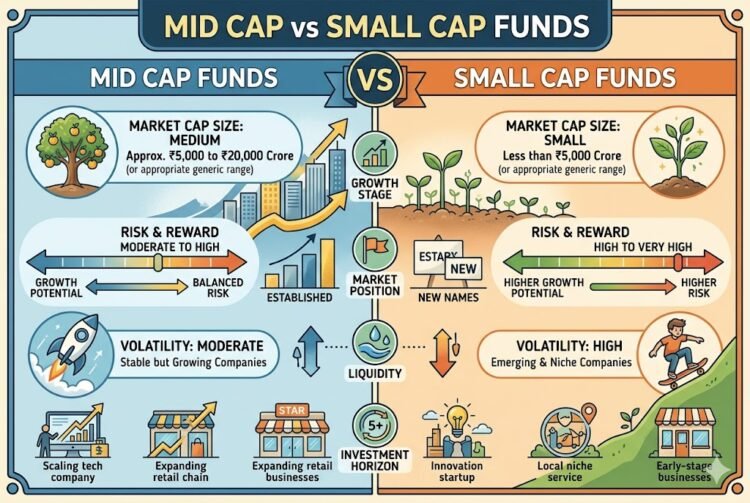
| Factor | Mid Cap | Small Cap |
| Business Profile | Established, more stable | Earlier-stage, higher growth potential |
| Volatility | Moderate | High |
| Liquidity | Better | Lower |
| Recovery After Crashes | Faster | Slower |
| Investor Attitude Required | Patient, moderate risk tolerance | High conviction, long-term temperament |
Risk Comparison: Mid-Cap vs Small-Cap Funds
| Risk Factor | Mid Cap Funds | Small Cap Funds |
| Overall Risk Level | Moderate | Meaningfully Higher |
| Drawdown During Corrections | Manageable | 50–60% in severe cases |
| Full Recovery Likelihood | High | Some never fully recovered |
| Panic Selling Tendency | Lower | Higher |
| Investability During Downturns | Holds through for most investors | Tests conviction severely |
Return Potential of Mid-Cap and Small-Cap Funds
Small-cap funds have delivered some of the most spectacular return figures in Indian mutual fund history during sustained bull markets. Investors are drawn to that track record because they may see the numbers without fully knowing the circumstances that led to them. Best mid-cap mutual funds offer returns competitive with small caps over seven to ten-year horizons – with fewer sleepless nights along the way.
Who Should Invest in Mid-Cap Mutual Funds?
For buyers seeking significant stock growth without the unpleasant instability that tiny caps can provide, the best mid-cap mutual funds are ideal. They are effective for investors who have a five- to seven-year time span, can handle modest volatility, and require their portfolio to be doable during downturns.
Who Should Invest in Small-Cap Mutual Funds?
The top 5 small-cap mutual funds are worth taking seriously for investors with a genuine seven-plus year horizon and the temperament to watch NAVs fall 30 percent without reaching for the redemption button. The extra instability is simply the entry cost to a category that rewards patience disproportionately over the long term.
Advantages of Investing in Mid-Cap Mutual Funds
Mid-caps offer a compelling combination — institutional analyst coverage, established business models, and growth potential that large-caps can no longer deliver. Best mid-cap mutual funds benefit from a company size that attracts enough attention to ensure liquidity without being so heavily tracked that alpha opportunities disappear.
Advantages of Investing in Small-Cap Mutual Funds
Small-cap funds access businesses before they become mainstream. The companies tracked by the top 5 small-cap mutual fund options today may be the mid-caps of tomorrow. For investors who identify quality early, the compounding over a full market cycle can be genuinely transformational.
Factors to Consider Before Choosing Between Mid-Cap and Small-Cap Funds
Three things matter most: investment horizon, emotional tolerance for drawdowns, and the proportion of the overall portfolio being allocated. An investor putting 10 percent of a diversified mutual fund portfolio into small caps is making a very different decision from one putting 60 percent. Proportion is risk management.
Common Mistakes Investors Should Avoid
Chasing the category with the highest recent return is the most common and most costly error. An investor who truly understands the difference between these two fund types will almost always make a better allocation decision than one simply pursuing recent numbers. The mistake is not investing in small caps – the mistake is investing with money that has a shorter psychological horizon than the fund actually requires.
Taxation Rules for Mid-Cap and Small-Cap Mutual Funds
- Both mid-cap and small-cap mutual funds are treated as equity funds for tax purposes.
- Gains on units held for more than twelve months are taxed as long-term capital gains at 10 percent above Rs 1 lakh per year.
- Gains on units held for under twelve months attract short-term capital gains tax at 15 percent.
- Holding period discipline here is not just an investment principle – it is a tax efficiency decision.
| You May Like to Read: Monthly Income Plan (MIP) With Mutual Funds
Conclusion
Neither category is universally superior. The best mid-cap mutual funds and the top 5 small-cap mutual fund options each serve a specific investor profile at a specific life stage. Getting that match right — rather than chasing returns — is what intelligent mutual fund investing actually looks like.