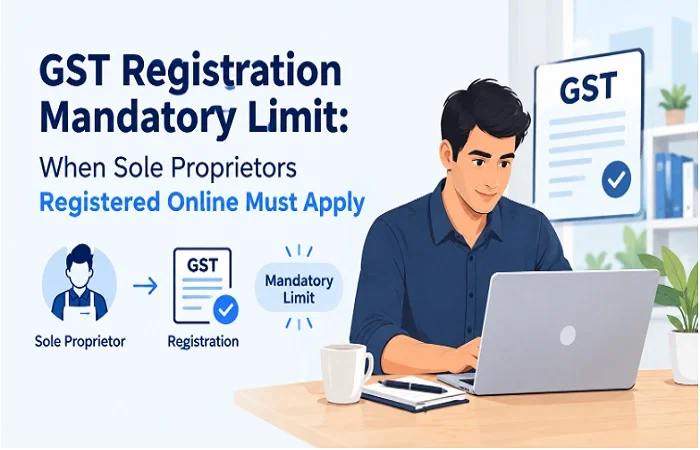
Online registration of a sole proprietorship business does not necessarily imply registration for GST. Both processes are distinct from each other. The requirements for compulsory GST registration will depend on several factors, such as total turnover, types of supply, place of supply, and certain transactions that make registration compulsory.
Getting this wrong can be costly. As per Section 122 of the CGST Act, failure to register yourself, when required, shall be subject to penalties under the law. Additionally, by staying unregistered, one would not be eligible for claiming input tax credit.
What Is the GST Registration Threshold Limit for Sole Proprietors?
GST registration becomes mandatory for a sole proprietorship once aggregate annual turnover exceeds ₹40 lakh for goods or ₹20 lakh for services, under the framework set by the CGST Act, 2017. Special category states apply lower thresholds.
Because a sole proprietorship registration online has no separate legal identity from its owner, the GST registration is obtained in the proprietor’s own name, using their PAN as the anchor identifier. The GSTIN issued is a 15-digit number derived from that PAN, and Aadhaar authentication is now central to how quickly it’s approved.
Threshold Table: Goods vs Services
| Category | Normal Category States | Special Category States |
| Supply of goods | ₹40 lakh | ₹20 lakh |
| Supply of services | ₹20 lakh | ₹10 lakh |
| Mixed supply (goods + services) | Threshold applicable to the dominant/relevant supply; verify with a tax advisor | Same, lower limit applies |
Special category states under GST include Arunachal Pradesh, Assam, Manipur, Meghalaya, Mizoram, Nagaland, Sikkim, Tripura, Himachal Pradesh, and Uttarakhand. If you operate from one of these states, don’t assume the ₹40 lakh/₹20 lakh limits apply to you; confirm the applicable state notification first.
Did You Know? GST applicability is based on aggregate turnover across all business verticals under the same PAN, not just the turnover of the one shop or activity you’re thinking about. If you run two unregistered ventures under your own PAN, their turnovers are added together for threshold purposes.
How Is “Aggregate Turnover” Calculated?
Aggregate turnover includes all taxable supplies, exempt supplies, exports, and inter-state supplies made under a single PAN, but excludes GST itself and inward supplies taxed under reverse charge.
This trips up a lot of freelancers and small traders who only count their “taxable” sales and leave out exempt income, assuming it doesn’t count toward the limit. It does. Practically:
- Included: Taxable sales, zero-rated exports, exempt supplies (e.g., unbranded agricultural produce), inter-state supplies
- Excluded: GST/cess collected, value of inward supplies under reverse charge, non-taxable supplies like the sale of land
Example: A Chennai-based freelance content consultant bills ₹15 lakh a year to Indian clients and another ₹6 lakh to a client based in the UK (an export of services, typically zero-rated but still counted in aggregate turnover). Her aggregate turnover is ₹21 lakh, over the ₹20 lakh services threshold, so registration is mandatory even though her domestic taxable billing alone looks well under the limit.
When Must a Sole Proprietor Register, Even Below the Turnover Limit?
GST registration is compulsory regardless of turnover if you fall into specific categories defined under Section 24 of the CGST Act; turnover exemptions do not apply to these.
| Trigger | Why It Overrides the Threshold |
| E-commerce operator or seller on a marketplace | Platforms like Amazon, Flipkart, or Zomato require a GSTIN before onboarding sellers |
| Casual taxable person | Occasional supply in a state with no fixed place of business |
| Non-resident taxable person | No exemption regardless of turnover |
| Liable to deduct TDS/collect TCS under GST | Registration is a compliance prerequisite |
| Agent supplying on behalf of another taxable person | Applies whether acting as principal or agent |
| Inter-state taxable supply of goods | With limited exceptions for small service providers and notified handicraft suppliers |
| Recipient liable under reverse charge mechanism | You must register to discharge that tax liability |
| Supplying online information/database services from outside India | Applies to overseas suppliers serving Indian consumers |
| Online money gaming supplied from outside India | Mandatory irrespective of turnover |
Common mistake: Assuming that selling only “a little” on an e-commerce marketplace keeps you exempt. It doesn’t; platform-based selling is one of the most common ways proprietors unknowingly cross into mandatory registration territory.
The 2026 GST Registration Process: What’s Changed
Registration itself has been substantially redesigned. Following the 56th GST Council meeting (3 September 2025) and Notification No. 18/2025–Central Tax, two new rules govern how fast, and how, a proprietor gets a GSTIN in 2026.
1. Rule 9A: Risk-Based Fast-Track Approval
Low-risk applicants who complete Aadhaar authentication for the proprietor can receive electronic approval within 3 working days of ARN generation. Standard (non-Aadhaar or flagged) applications go through officer verification, typically resolved within 7 working days, extending to 30 days if physical premises verification is triggered.
2. Rule 14A: Simplified Route for Small B2B Suppliers
Small taxpayers with an estimated monthly output tax liability of ₹2.5 lakh or less can opt into a fully electronic, Aadhaar-based registration route with minimal manual scrutiny. This is opt-in, selected in Part A of FORM GST REG-01, and comes with defined withdrawal conditions, including a requirement to have filed all pending returns before exiting the scheme.
What Is the GST Registration Approval Timeline in 2026?
Aadhaar-authenticated, low-risk applicants are typically approved within 3 working days. Standard applications without a query take about 7 working days. Cases flagged for biometric or physical verification can take up to 21–30 working days.
Latest News: As of February 2025, applicants no longer need to travel to a different state for biometric Aadhaar verification; it can now be completed at a GST Suvidha Kendra (GSK) in their home state, even when registering a business elsewhere.
Documents Required for Sole Proprietorship GST Registration
- PAN card of the proprietor
- Aadhaar card (mandatory for authentication under the fast-track route)
- Passport-size photograph
- Proof of business address (electricity bill, rent agreement, or NOC from the property owner)
- Bank account proof (cancelled cheque, bank statement, or first page of the passbook)
- Business registration proof, if any (Udyam certificate, shop and establishment license)
GST Registration Compliance Checklist for Sole Proprietors
- Calculate aggregate turnover across all activities under your PAN
- Compare it against the applicable state threshold (normal vs special category)
- Check whether any Section 24 trigger applies, irrespective of turnover
- Apply within 30 days of becoming liable
- Complete Aadhaar authentication to access the fast-track route
- Keep invoices, bank statements, and turnover records ready for verification
- File returns from the effective date of registration, even during the approval window
Penalties for Not Registering on Time
Failure to register when liable attracts a penalty of ₹10,000 or the amount of tax evaded, whichever is higher, under Section 122 of the CGST Act, 2017. Beyond the direct penalty, you also lose eligibility to claim input tax credit (ITC) for the unregistered period, and clients may withhold payments pending a valid GSTIN for invoicing purposes.
Case Study: A Bengaluru-based sole proprietor selling handmade goods crossed ₹42 lakh in annual turnover while listing products on a marketplace app. She had assumed the ₹40 lakh threshold gave her a buffer because her “own website” sales were below it, but marketplace selling itself is a mandatory-registration trigger regardless of turnover, and her aggregate turnover (website + marketplace) had already crossed the goods threshold months earlier. She was assessed a penalty and had to backdate compliance, including unclaimed ITC on business purchases made during that period.
GST Registration vs No Registration
| Aspect | Registered | Unregistered (Below Threshold, No Trigger) |
| Input Tax Credit | Can claim ITC on purchases | Cannot claim ITC |
| Interstate Trade | Freely allowed | Restricted in several scenarios |
| E-commerce Selling | Permitted | Not permitted without GSTIN |
| Business Credibility | Higher, especially for B2B clients | Often questioned by larger clients |
| Compliance Burden | Regular return filing required | None |
| Penalty Risk | None, if compliant | High, if liability is later established |
Businesses below the threshold can still register voluntarily, a common choice for freelancers and early-stage proprietors who want ITC benefits and B2B credibility before they’re legally required to register.
Conclusion
GST registration threshold for a sole proprietor is not one number you can memorize and forget about. It is a function of your turnover, your state, and a list of activity-based triggers which make your turnover irrelevant. A turnover threshold above ₹40 lakh in case of goods and ₹20 lakh in case of services is compulsory, but even something like listing your product on an e-commerce website or reverse charge liability would qualify you for registration.
Under the 2026 track process, which will use the Aadhaar database to register people, compliance-minded sole proprietors can do it in three days, provided that they are aware of it. The penalty and lost ITC for missing the assessment are much higher than doing it beforehand via a professional.